Reduce Pending Fees at Your Coaching Institute | Eduvora360
Learn how to reduce pending fees at your coaching institute with clear fee policies, automated reminders, simple payment options, and real-time tracking. Discover practical strategies to improve fee collection and maintain healthy cash flow.
How to Reduce Pending Fees at Your Coaching Institute : Your classes are running well. Students are attending, teachers are focused, and parents are satisfied.
But as the month comes to an end, the same problem appears again: several student fees are still pending.
Your team checks registers, searches through spreadsheets, sends WhatsApp messages and calls parents one by one. Some parents pay immediately. Some ask for more time. Others say they have already paid, but your staff cannot quickly find the record.
Most fees may eventually be collected, but the process takes valuable time and creates uncomfortable conversations.
Pending fees are not only an administrative problem. They directly affect your institute’s cash flow. When payments are delayed, it becomes harder to plan salaries, rent, study materials, marketing expenses and daily operations.
The solution is not to call parents more frequently or send stricter messages.
The better solution is to create a clear and professional fee collection system.
With fixed policies, timely reminders, convenient payment options and real-time tracking, your institute can reduce pending fees while maintaining a respectful relationship with parents.
Here is a practical system you can start using.
Why Do Coaching Fees Remain Pending?
Most parents do not delay fees intentionally. In many cases, the payment remains pending because the process is unclear or inconvenient.
Understanding the common reasons can help you improve your fee collection process.
There is no clear payment date
Parents may know the fee amount but not the exact due date.
Terms such as “pay at the beginning of the month” or “submit the fee soon” are open to interpretation. One parent may pay on the first, while another may wait until the fifteenth.
A specific deadline, such as “Fees are payable by the fifth of every month,” creates clarity.
Parents forget the due date
Parents manage school expenses, household bills, work responsibilities and many other payments. Even responsible parents can forget a coaching fee deadline.
A short reminder before the due date often solves the problem.
The payment process takes too much effort
When parents must visit the institute, ask for account details or wait for someone to share a QR code, payment can be delayed.
The easier the payment process is, the faster parents can complete it.
The institute discovers pending fees too late
If payment records are maintained in registers or separate Excel sheets, the owner may not know the total pending amount until the end of the month.
By that time, several small delays may have become a major collection problem.
Follow-ups are not organised
Some parents may receive repeated reminders while others receive none. This usually happens when fee follow-ups depend on staff memory instead of a fixed system.
A planned reminder schedule makes the process consistent and professional.
1. Set a Clear Fee Policy During Admission
The best time to prevent late payments is when the student joins your institute.
Every parent should receive a clear written fee policy containing:
- Total course fee
- Monthly or instalment amount
- Exact payment dates
- Accepted payment methods
- Late-payment process
- Refund and cancellation rules
- Contact details for fee-related support
The policy does not need to sound strict. It should simply remove confusion.
For example:
The monthly coaching fee is payable by the fifth of every month. A reminder will be shared before the due date. Payments can be made through cash, UPI or the available online payment option.
Share this policy through the admission form, a printed document, email or WhatsApp.
Ask the parent to confirm that they have understood the payment schedule.
When the terms are explained at the beginning, future follow-ups become easier. Your staff can refer to the agreed policy instead of creating different rules for different families.
2. Send Reminders Before the Due Date
Do not wait until the fee becomes overdue before contacting the parent.
A reminder sent two or three days before the due date feels helpful. A message sent several days after the deadline can feel like a complaint.
Your reminder should be short, polite and easy to understand.
Reminder two or three days before the due date
Namaste [Parent Name], this is a friendly reminder that [Student Name]’s coaching fee of ₹[Amount] is due on [Date]. You may pay through UPI at [UPI ID] or use this payment link: [Link]. Thank you. – [Institute Name]
Reminder on the due date
Hello [Parent Name], [Student Name]’s coaching fee of ₹[Amount] is due today. You can complete the payment through UPI at [UPI ID] or use this link: [Link]. Thank you for your support. – [Institute Name]
Always include the student’s name, amount, due date and payment option.
Parents should not need to call your office to ask how much they need to pay or where they should send it.
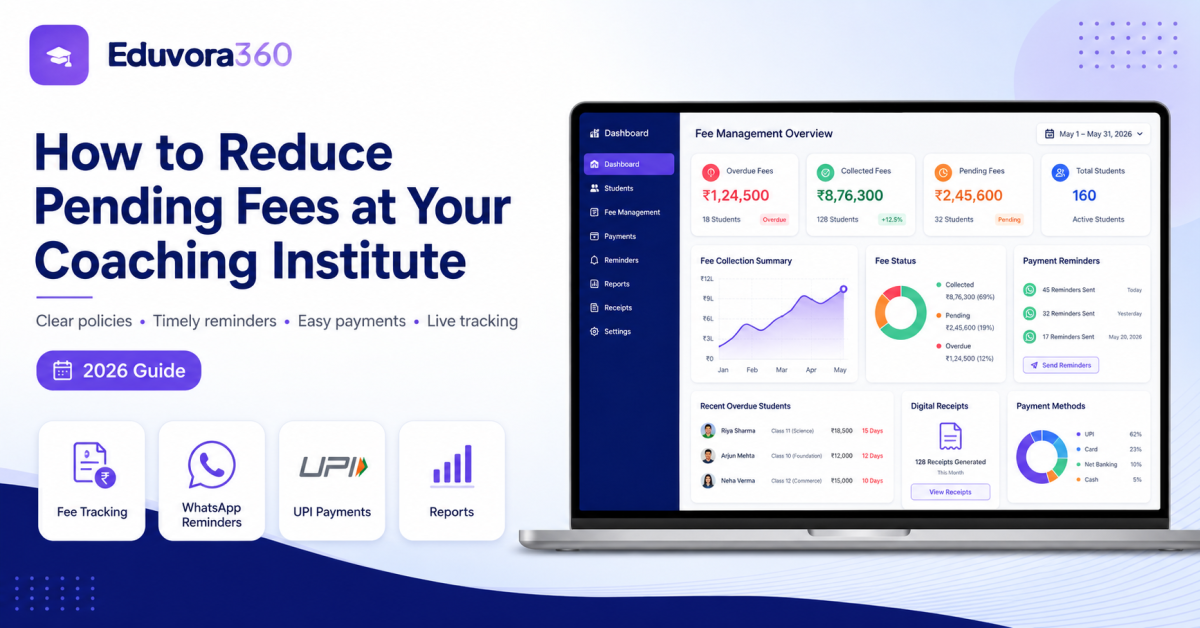
Eduvora360 includes fee-tracking and WhatsApp reminder tools that help institutes identify pending accounts and send follow-ups without manually checking multiple records. Its dashboard is designed to show overdue fees and related follow-up information in one place.
3. Make the Payment Process Simple
Every extra step creates another reason to delay payment.
Parents are more likely to pay on time when they can complete the process quickly from their phones.
Provide a fixed UPI option
Use one official UPI ID or QR code for the institute. Avoid changing the payment number regularly, as it may confuse parents.
Share a direct payment link
A direct payment link allows the parent to complete the transaction without searching for bank details.
Continue accepting cash when needed
Some parents may still prefer cash. Record the payment immediately and issue a receipt.
Send a digital receipt
After payment, provide a receipt containing:
- Student’s name
- Amount paid
- Payment date
- Payment method
- Fee month or instalment
- Receipt number
- Remaining balance, where applicable
A receipt confirms that the payment has been received and correctly recorded. It also reduces disputes and repeated calls.
4. Track Pending Fees in Real Time
You cannot manage what you cannot clearly see.
At any point, your institute should be able to answer:
- Which students have pending fees?
- What is the total pending amount?
- Which payments are due this week?
- How long has each payment been overdue?
- Which parents have already been contacted?
- Which students are paying in installments?
When information is maintained in separate registers, spreadsheets and WhatsApp chats, answering these questions can take hours.
A live fee dashboard gives the owner and authorised staff a clear view of collected, pending and overdue payments.
Eduvora360’s owner dashboard brings fee information together with students, batches, attendance, enquiries and finance records. The website also highlights instant visibility into overdue fees and one-click reminder workflows.
Real-time tracking allows you to act early.
A polite reminder three days after the due date is much easier than a stressful collection call after one month.
It also improves financial planning because you know how much has been collected and how much is still expected.
5. Follow a Fixed Reminder Schedule
Fee collection should not depend on staff memory or frustration.
Create a standard follow-up schedule and use it for every student.
A practical schedule could be:
Three days before the due date:
Send a friendly reminder.
On the due date:
Send a short payment notification.
Three days after the due date:
Send a polite pending-fee reminder.
Seven days after the due date:
Send a direct but respectful follow-up.
Ten to fifteen days after the due date:
Make a phone call to understand the reason for the delay.
When every parent receives the same type of reminder at the same stage, the process stops feeling personal.
It becomes a normal part of institute administration.
6. Use Professional Pending-Fee Messages
Your message should clearly communicate that payment is pending without sounding rude or threatening.
First pending-fee reminder
Namaste [Parent Name], our records show that ₹[Amount] for [Student Name] is still pending. You can make the payment through UPI at [UPI ID] or use this link: [Link]. Please ignore this message if payment has already been completed and share the transaction details for verification. Thank you. – [Institute Name]
Second follow-up message
Hello [Parent Name], this is a reminder regarding the pending coaching fee of ₹[Amount] for [Student Name]. Kindly complete the payment by [Date]. Please contact us if you need assistance or would like to discuss an instalment plan. – [Institute Name]
Always send fee messages privately.
Never discuss a student’s pending payment in a public WhatsApp group or in front of other students and parents.
Respectful communication protects trust and makes the conversation easier for both sides.
7. Offer Structured Instalment Plans
Some families may face a temporary financial problem.
In such situations, a clear instalment plan is better than leaving the payment open-ended.
The agreement should include:
- Total pending amount
- Number of instalments
- Amount of each instalment
- Due date for each payment
- Payment method
- Written confirmation from the parent
For example:
The pending amount of ₹12,000 will be paid in three installments of ₹4,000 on 10 August, 10 September and 10 October.
This is clearer than accepting a promise such as “We will pay soon.”
Confirm the installment plan through WhatsApp or a written document and record every payment against the student’s profile.
8. Keep Complete Fee Records for Every Student
Each student’s fee record should include:
- Total course fee
- Amount received
- Pending balance
- Payment dates
- Payment methods
- Instalment schedule
- Discounts or scholarships
- Receipt history
- Parent contact details
- Follow-up history
Keeping all this information in one place prevents errors.
Your team will not send reminders to parents who have already paid. Staff can also answer payment-related questions quickly without searching through multiple files.
Eduvora360 uses connected student records, which means fee information can remain linked with the relevant student, batch and parent profile rather than being managed in separate systems.
9. Assign Fee Management to a Responsible Team Member
Fee collection becomes confusing when everyone assumes someone else is managing it.
Assign one administrator, accountant or counsellor to take responsibility for fee records.
This person should:
- Review pending payments
- Update completed transactions
- Verify UPI or bank payments
- Send scheduled reminders
- Track instalment dates
- Contact parents when required
- Report long-overdue payments to the owner
Other team members can support the process, but one person should remain responsible for keeping the records accurate.
Eduvora360 provides separate logins for owners, staff and parents. Owners can view the complete institute dashboard, staff members can access their relevant work, and parents can view information connected to their own child.
10. Review Fee Reports Every Week
Do not wait until the final day of the month.
Review your fee collection report at least once a week.
Check:
- Total fees due
- Total amount collected
- Total pending amount
- Number of overdue students
- Payments delayed by more than seven days
- Missed instalments
- Parents who have not responded
Weekly reviews help you identify problems early.
They also allow you to measure whether your process is improving. You can compare pending amounts from one month to the next and see which reminder timings work best.
How Eduvora360 Supports Better Fee Management
Eduvora360 is an all-in-one management platform built for coaching institutes in India. Its dashboard brings students, batches, attendance, fees, finance, enquiries, results and related institute operations into one connected system.
For fee management, the platform helps institutes:
- View collected and pending fees
- Identify overdue student accounts
- Keep student-wise payment records
- Use WhatsApp reminder workflows
- Maintain connected fee and student data
- Access finance and GST-related reporting
- Give owners and staff separate access
- Provide parents with their own portal
- Access the system through mobile and desktop browsers
The platform does not require a separate app, and Eduvora360 states that its team handles personal onboarding, including the setup of batches, subjects, staff accounts, fee structures and the finance portal. The website says institutes can be made ready to use the system within 24 hours.
This makes the software relevant for institutes that want to move away from registers, scattered spreadsheets and repeated manual follow-ups.
Common Fee Collection Mistakes to Avoid
Waiting until the end of the month
By the time you review payments, several accounts may already be overdue.
Sending emotional messages
A frustrated message can damage your relationship with parents. Keep every communication calm and professional.
Maintaining incomplete records
Incorrect records can result in reminders being sent to parents who have already paid.
Using different payment accounts
Changing UPI numbers or account details creates confusion and delays.
Accepting open-ended promises
Always agree on a specific payment date or installment plan.
Sending too many reminders
Follow a planned schedule. Excessive messages can feel uncomfortable, while irregular reminders can reduce collection efficiency.
Final Thoughts
Pending fees do not always mean that parents are unwilling to pay.
In many cases, the real problem is the absence of a clear and organised fee collection process.
To reduce pending fees at your coaching institute:
- Explain the fee policy during admission
- Set a fixed payment date
- Send reminders before the due date
- Provide convenient payment options
- Issue digital receipts
- Track payments in real time
- Follow a consistent reminder schedule
- Offer structured instalment plans when required
- Review fee reports every week
Most importantly, stop treating every pending payment as a difficult personal conversation.
Turn fee collection into a standard business process.
Eduvora360 helps coaching institutes organise student records, fees, overdue payments, reminders and financial information from one connected dashboard. Its live demo allows institute owners to explore the platform before deciding whether it fits their workflow.
Stop running this on a register and an Excel sheet
Eduvora360 gives the owner, every teacher and every parent their own login — students, fees, attendance, results and a full finance portal, all sharing one dataset.